
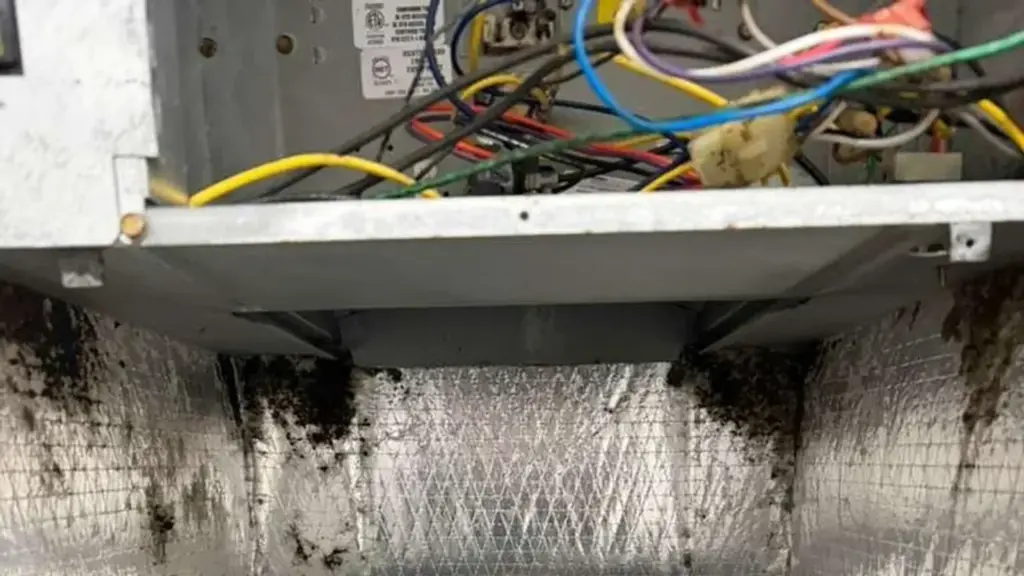
Why Tampa’s Humidity Creates Dusty, Contaminated Air Ducts
Florida ranks among the most humid states in the country, and Tampa’s subtropical climate means indoor relative humidity can stay elevated for months at a stretch. That persistent moisture does not just affect your comfort, it actively changes what accumulates inside your home’s ventilation system. If your vents seem to collect dust faster than they should, or if you notice a musty undertone when the AC kicks on, Tampa’s climate is very likely part of the explanation.
How does humidity get inside air ducts in the first place?
Warm, moisture-laden outdoor air constantly pushes against the building envelope of a Tampa home. Every time a door opens, every small gap around a duct joint, and every penetration through a wall or ceiling is a potential entry point. Inside the duct system, cooled surfaces create a temperature difference that causes water vapor to condense, much like a cold glass sweating on a summer afternoon. Flex duct, which is common in Florida construction, has an inner liner that can hold condensation in its folds. Over time, that trapped moisture becomes the foundation for biological growth and a magnet for airborne particles.
Why does moisture cause dust to accumulate faster?
Dry dust particles are relatively light and tend to stay suspended in airflow. When humidity rises, those particles absorb moisture and become heavier and stickier. They cling to duct walls, to insulation fibers, and to each other, forming dense layers that ordinary airflow cannot dislodge. In Tampa homes where the AC runs most of the year, the fan cycles push air through the system hundreds of times a day, compressing and compacting that sticky debris with every pass. What might take years to accumulate in a drier climate can build up noticeably faster here.
What is the connection between dusty ducts and biological growth?
If you want it handled correctly the first time, consider professional air duct cleaning in Tampa.
Organic material, skin cells, pollen, pet dander, and food particles, settles into duct debris along with inorganic dust. When moisture is present, that organic layer becomes a nutrient source. Spores that are naturally present in outdoor air (and in every Tampa home) can find those damp, dusty surfaces hospitable. The result is a cycle: moisture encourages accumulation, accumulation retains more moisture, and the combination creates conditions where biological growth can take hold. This does not mean every dusty duct has a serious problem, but it does explain why Tampa homeowners often notice issues that their relatives in drier states simply do not deal with. For a closer look at specific warning signs, see the warning signs Tampa homeowners should watch for.
Why is Tampa specifically more at risk than other Florida cities?
Tampa sits on a peninsula bounded by Tampa Bay to the west and Hillsborough Bay to the south, with the Gulf of Mexico close by. That geography means sea breezes carry salt-laden, high-humidity air directly into residential neighborhoods throughout the year. The city averages more than 50 inches of rainfall annually, concentrated in a summer rainy season that runs from roughly June through September. During those months, outdoor dew points frequently climb into the low 70s, making it nearly impossible for a home’s HVAC system to fully dehumidify without running almost continuously. Homes in older neighborhoods like Seminole Heights, Ybor City, and parts of South Tampa often have original or older ductwork that was not designed with today’s understanding of moisture management, compounding the problem.
Does running the AC constantly make duct contamination worse?
Counterintuitively, yes, in some ways. A system that runs for long, continuous cycles does a better job of dehumidifying than one that short-cycles, but the sheer volume of air moving through the ductwork also moves more particles. The evaporator coil, which is responsible for cooling and dehumidifying, can become a collection point for dust and biological matter if the air filter is not changed regularly. When the coil is partially restricted, it runs colder and creates more condensation in the supply plenum and nearby duct sections. That localized moisture then wicks into surrounding duct material, accelerating the accumulation cycle described above.
Can a good air filter solve the humidity-and-dust problem on its own?
Many Tampa homeowners rely on expert air duct cleaning in Tampa for exactly this.
A quality filter with an appropriate MERV rating is an important first line of defense, and changing it on schedule is one of the most effective things a Tampa homeowner can do. However, filters capture particles in the return airstream, they do not address debris that has already settled into duct walls, and they do not control moisture inside the duct system itself. A filter also cannot reach the supply plenum, the coil area, or the branch runs where accumulated material sits undisturbed. Think of a filter as ongoing maintenance that slows future buildup; it is not a retroactive cleaning tool. For guidance on keeping your system in good shape between professional visits, this guide on maintaining clean HVAC ducts in Tampa covers practical steps homeowners can take.
How do I know if my ducts have a moisture-related contamination problem?
Several indicators are worth paying attention to. A musty or earthy smell that appears when the system first starts up often points to biological growth somewhere in the air path. Visible dark staining around supply registers, particularly on the ceiling drywall surrounding a vent, can indicate condensation and particulate deposit. Uneven airflow between rooms sometimes reflects blockage from accumulated debris. Allergy-like symptoms that seem worse indoors than outdoors, or that improve when windows are open, are another signal that the air circulating through the system may be carrying elevated levels of particulates. If you are unsure what you are looking at, a professional ductwork inspection can clarify the situation. Questions to ask before a Tampa ductwork inspection can help you prepare for that conversation.
What does a professional duct cleaning actually do about the moisture cycle?
A thorough cleaning removes the accumulated debris that retains moisture and provides a substrate for biological growth. Technicians use negative-pressure equipment to dislodge and capture material from inside the duct walls, the plenum, and the branch runs without spreading it into the living space. After the debris is removed, the surfaces are less hospitable to future accumulation, and airflow is restored to design levels. In some cases, a technician may identify specific areas where condensation is forming due to insulation gaps or disconnected joints, which can then be sealed to reduce ongoing moisture intrusion. Cleaning does not permanently eliminate the conditions that Tampa’s climate creates, but it resets the system and interrupts the accumulation cycle. To understand the full scope of what professional service involves, our complete guide to air duct cleaning in Tampa walks through the process in detail.
Ready for the next step? Learn how air duct cleaning services in Tampa can help and reach out to the team.
How often should Tampa homeowners schedule duct cleaning given the local climate?
Industry guidance generally points to a range of every three to five years for most homes, but Tampa’s conditions can push that toward the shorter end of the range. Homes with pets, households where members are sensitive to airborne particles, and properties with older flex duct or fiberglass duct board may benefit from more frequent attention. After a major renovation, a flooding event, or a period when the AC was out of service during the summer rainy season, scheduling an inspection sooner rather than waiting for the next routine interval makes practical sense. If you want a clearer picture of what drives the timing and scope of service, the professional duct cleaning guide for Tampa homeowners covers those factors in depth.
Is duct replacement ever the right answer instead of cleaning?
Cleaning is the appropriate starting point for most systems, but there are situations where the ductwork itself has deteriorated to the point where cleaning provides only temporary benefit. Flex duct that has collapsed sections, fiberglass duct board with saturated insulation, or systems with persistent moisture intrusion from unsealed joints may need repair or replacement to address the root cause. A professional inspection can distinguish between a system that needs cleaning and one where the duct material itself has been compromised. Ecovent Dryer Duct Solutions Tampa offers both air duct cleaning and air duct replacement, so the recommendation will match what the system actually needs rather than a one-size-fits-all answer.
Tampa’s humidity is not something homeowners can change, but understanding how it interacts with your ventilation system puts you in a much better position to manage it. Dusty, moisture-affected ducts are a predictable result of the local climate, and a solvable one. If your system has not been inspected or cleaned recently, or if you are noticing any of the signs described above, reaching out to a qualified local technician is a practical next step. Contact Ecovent Dryer Duct Solutions Tampa to schedule an inspection and get a clear picture of what your ductwork actually needs.