
How to Inspect Your Tampa HVAC Ducts: Cleaning vs. Replacement Compared
When ductwork quietly degrades inside a Tampa home, the first sign is rarely dramatic. Utility bills creep up. One room never quite cools down. A faint musty odor lingers even after the AC runs all afternoon. By the time most homeowners in the Tampa Bay area notice something is wrong, the system has been working harder than it should for months. The real question at that point is not whether to act, but which action makes sense: a thorough professional cleaning, or a full duct replacement?
Those two paths lead to very different outcomes and very different scopes of work, and Tampa’s environment adds a layer of complexity that homeowners in drier climates simply do not face. High year-round humidity, older flex-duct construction common in homes built before the mid-2000s, and the relentless demand placed on HVAC systems running nearly every month of the year all affect how quickly ductwork wears out and how well it responds to cleaning. This guide walks through how to assess your system, what each option actually involves, and how to match the right solution to what your ducts actually need.
For a full breakdown of when replacement becomes the clearer choice, see our complete air duct replacement guide for Tampa homeowners.
Understanding What a Duct Inspection Actually Reveals
A proper inspection is the foundation of any honest cleaning-versus-replacement decision. Without one, any recommendation is a guess. In Tampa, a thorough assessment looks at four things: the physical condition of the duct material, the presence and nature of contamination inside the system, airflow performance at the registers, and the age and installation history of the ductwork.
Flex duct, which makes up the majority of residential systems in Tampa-area homes built from the 1980s through the early 2000s, is particularly vulnerable to sagging, kinking, and inner liner collapse. These are structural problems that cleaning cannot fix. A technician using a video inspection camera can identify collapsed sections, disconnected joints, and areas where the inner liner has separated from the outer insulation jacket. Sheet metal ductwork, more common in commercial buildings and some older Tampa homes, tends to hold its shape longer but can develop rust, joint separation, and insulation breakdown in the humid Florida environment.
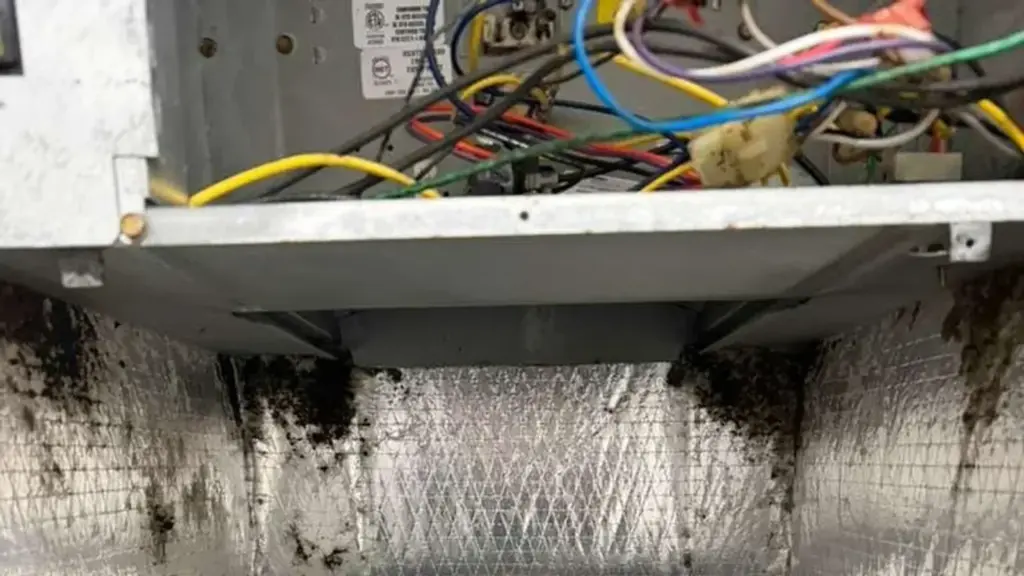
Contamination inside the duct tells a separate story. Dust buildup alone, even heavy buildup, is generally a cleaning candidate. What changes the calculus is the presence of visible microbial growth, rodent activity, or construction debris that has been drawn into the system. Each of those conditions requires a different response, and not all of them are resolved by cleaning alone.
Homeowners can do a limited visual check by removing a few supply and return vent covers and shining a flashlight into the duct opening. What you can see from the register, however, is a small fraction of the total system. A professional inspection using camera equipment covers the full run of each duct branch, including the areas inside walls and above ceilings where damage most often goes undetected. If you have already noticed some of the warning signs described in our guide to bad ductwork symptoms in Tampa, a camera inspection is the logical next step before committing to either service.
What Professional Air Duct Cleaning Involves
Air duct cleaning in Tampa follows a process built around negative pressure and mechanical agitation. A high-powered vacuum unit is connected to the main trunk line, creating suction throughout the system. Technicians then work through each supply and return branch using rotary brushes, compressed air whips, or both, dislodging accumulated dust, debris, and biological material so the vacuum can capture it before it re-enters the living space.
The process works well when the ducts themselves are structurally sound. A flex duct that is properly supported, fully intact, and free of disconnections will respond well to cleaning. The inner liner stays in place, the agitation tools move through without snagging, and the result is a noticeably cleaner system. Homeowners often notice the air feels fresher and that registers deliver more consistent airflow after a proper cleaning, because accumulated debris at the register boots and in the plenum had been partially restricting flow.
If you want it handled correctly the first time, consider professional air duct cleaning in Tampa.
What cleaning does not address is physical damage. A kinked or collapsed section of flex duct restricts airflow whether it is clean or dirty. A disconnected joint leaks conditioned air into the attic whether the interior surfaces are spotless or coated in dust. These are structural problems, and no cleaning process changes the geometry of a compromised duct run.
Cleaning is also not a permanent solution for active microbial growth. If the underlying moisture condition that allowed growth to develop has not been corrected, the same environment that produced the problem initially will produce it again. In Tampa’s climate, that moisture source is often a combination of high ambient humidity and a duct system that has lost enough insulation integrity to allow condensation on the duct surface. Cleaning addresses the symptom; fixing the insulation or sealing the duct addresses the cause.
What Duct Replacement Actually Entails
Replacement means removing the existing ductwork entirely and installing a new system designed to current standards. In Tampa, that typically means new flex duct with the appropriate insulation rating for Florida’s climate (R-6 or R-8 is standard for unconditioned attic spaces), properly sized for the HVAC equipment in place, and installed with attention to support spacing and joint sealing that older installations often lacked.
The scope of a replacement project varies depending on the home. A single-story ranch-style home with attic access throughout is a straightforward project. A two-story home with ductwork routed through interior walls or a slab-on-grade home with in-slab duct runs presents more complexity. Understanding those variables is part of what makes a detailed inspection so important before any decision is made. For a deeper look at what drives the scope and complexity of a replacement project in the Tampa area, this breakdown of ductwork cost factors covers the key variables worth knowing before you get a quote.
Replacement makes sense when the existing system has reached the end of its useful life, when structural damage is widespread rather than isolated, or when the layout of the current system is fundamentally mismatched to the home’s cooling load. Tampa homes that have had additions built without corresponding duct extensions, or that have had HVAC equipment upgraded to a larger or more efficient unit without duct resizing, often have systems that were never right to begin with. Cleaning a poorly designed system makes it a clean, poorly designed system. Replacement is the opportunity to correct the design at the same time.
Tampa’s Climate and Housing Stock: Why the Decision Is Different Here
Tampa’s subtropical climate is not incidental to this decision. It is central to it. The combination of high humidity from June through October, mild winters that still require occasional heating, and the near-constant demand on HVAC systems creates conditions that age ductwork faster than in most U.S. markets.
Attic temperatures in Tampa can exceed 140 degrees Fahrenheit on summer afternoons. Flex duct exposed to those temperatures for years gradually loses the flexibility that makes it functional. The inner liner becomes brittle, the wire coil that holds its shape can shift, and the outer insulation jacket degrades. A system that looked acceptable five years ago may have deteriorated significantly by now, particularly if it was installed during the construction boom of the late 1990s and early 2000s when Tampa’s housing stock expanded rapidly and installation quality varied.
Humidity also affects the decision in a more direct way. Ducts that pass through unconditioned attic space are subject to significant temperature differentials between the conditioned air inside and the hot, humid air outside. When duct insulation is compromised, that differential can produce condensation on the duct surface, which creates conditions favorable to microbial growth and accelerates the breakdown of the duct material itself. This is a known and common issue in Tampa-area homes, and it is one reason that a professional inspection here should always include an assessment of insulation integrity, not just interior cleanliness.
Many Tampa homeowners rely on expert air duct cleaning in Tampa for exactly this.
Older Tampa homes, particularly those built before 1985, sometimes have duct systems that were originally designed for smaller or less efficient HVAC equipment. When those systems are upgraded, the ducts are not always resized to match. The result is a mismatch between the system’s capacity and the duct’s ability to distribute it, which no amount of cleaning will correct. Understanding whether your home’s duct layout belongs to this category is part of what a thorough inspection should answer. The causes of duct deterioration specific to Tampa go into more detail on how the local environment accelerates wear.
Side-by-Side Comparison: Cleaning vs. Replacement
| Criterion | Professional Duct Cleaning | Full Duct Replacement |
|---|---|---|
| Best suited for | Structurally intact ducts with accumulated dust, debris, or light contamination | Ducts with physical damage, collapsed sections, disconnections, or end-of-life material |
| Addresses airflow restrictions from damage | No, cleaning cannot restore collapsed or kinked duct geometry | Yes, new installation corrects layout and sizing issues |
| Disruption to the home | Low, technicians work through existing registers and access points | Moderate to high, attic access required; some ceiling or wall access may be needed |
| Typical timeframe | A few hours for most residential systems | One to several days depending on home size and layout |
| Resolves microbial growth risk | Partially, removes existing material but does not fix underlying moisture conditions | Yes, new insulated duct eliminates the compromised material and, if properly installed, reduces condensation risk |
| Appropriate for Tampa attic flex duct over 15-20 years old | Unlikely, material degradation at this age typically warrants replacement | Yes, replacement restores system integrity and insulation performance |
Which Option Is Right for Tampa Homes: A Practical Verdict
The honest answer is that cleaning and replacement are not competing services so much as they are appropriate responses to different conditions. The inspection findings, not a preference for one service or the other, should drive the recommendation.
Cleaning is the right starting point when the ductwork is structurally sound, the system is less than 15 years old, and the contamination found is primarily dust and particulate matter rather than evidence of moisture damage or structural failure. Many Tampa homes in this category benefit significantly from a professional cleaning, and the results are noticeable in airflow quality and system efficiency.
Replacement becomes the appropriate path when the inspection reveals collapsed or disconnected sections, when the duct material has visibly degraded, when the system is old enough that its remaining service life is limited regardless of cleaning, or when the existing layout is fundamentally mismatched to the home’s needs. In Tampa, homes with flex duct systems installed before the mid-2000s are frequently in this category, particularly if the ducts have never been inspected or serviced.
There is also a middle path worth knowing about: targeted repair combined with cleaning. When damage is isolated to one or two sections of an otherwise sound system, repairing those sections and then cleaning the full system can extend the useful life of the ductwork without the scope of a full replacement. A thorough inspection is what makes that determination possible.
If you are working through this decision for your Tampa home and want to understand the full indicators that point toward replacement specifically, the complete replacement indicators checklist lays out each condition in detail. And if you are still in the early stages of understanding what your ducts look like, this comparison of cleaning and replacement for Tampa homeowners provides additional context for making an informed choice.
Ready for the next step? Learn how air duct cleaning services in Tampa can help and reach out to the team.
Frequently Asked Questions
Can I inspect my own ductwork in a Tampa home?
A homeowner can do a basic visual check by removing vent covers and looking into the first few feet of each duct with a flashlight. That reveals surface-level dust and obvious damage near the register. It does not show the condition of duct runs inside the attic, behind walls, or at the connections to the air handler, where the most significant problems typically develop. A professional camera inspection covers those areas and gives you a complete picture before committing to any service.
How long does flex duct typically last in a Tampa attic?
Flex duct installed in Tampa attics is generally rated for 15 to 25 years under normal conditions, but the combination of extreme attic heat, high humidity, and near-constant system operation in Florida often puts systems toward the lower end of that range. Ducts from the late 1990s and early 2000s that have never been inspected are frequently past the point where cleaning alone is the right answer.
Does duct cleaning help with high energy bills in Tampa?
It can, when the cause of high bills is debris-related airflow restriction in an otherwise sound system. If the cause is instead disconnected joints leaking conditioned air into the attic, collapsed sections forcing the blower to work harder, or duct insulation that has degraded to the point where heat transfer is significant, cleaning will not produce meaningful efficiency gains. The inspection findings determine which scenario applies.
What signs during a basic inspection suggest replacement rather than cleaning?
Visible sagging or kinking in flex duct runs, sections where the inner liner appears to have separated from the outer jacket, any evidence of pest activity inside the duct, and registers that deliver noticeably weak airflow despite a functioning HVAC unit are all indicators worth taking seriously. Any of these findings, confirmed by a professional inspection, typically points toward replacement or at minimum targeted repair rather than cleaning alone.
Is duct cleaning or replacement more disruptive to a Tampa home?
Cleaning is significantly less disruptive. Technicians work through existing access points and registers, and most residential jobs are completed in a few hours with no structural changes to the home. Replacement requires attic access throughout the project and may involve some ceiling or wall work depending on how the existing system is routed. For most Tampa homes with attic-mounted ductwork, the replacement process is contained to the attic space, but the timeline is longer and the project scope is larger.
Should I clean ducts before replacing them if replacement is the plan?
Generally, no. If a professional inspection confirms that replacement is the appropriate course of action, cleaning the old system first adds time and expense without changing the outcome. The new installation starts clean by definition. The exception would be a situation where replacement is planned for a future date and cleaning in the interim provides a meaningful improvement in air quality or system performance in the meantime.
Making the Right Call for Your Tampa Home
The ductwork inside a Tampa home is doing quiet, continuous work in conditions that are genuinely demanding. High heat, persistent humidity, and a system that rarely gets a seasonal break all contribute to wear that accumulates faster than most homeowners expect. The decision between cleaning and replacement is not one-size-fits-all, and the right answer for your home depends on what an honest inspection actually finds.
If your system is due for an assessment, or if you have noticed any of the airflow, efficiency, or air quality changes described here, reaching out to schedule a professional inspection is the most straightforward next step. An accurate picture of your duct condition is the only reliable foundation for making a decision that fits your home, your system, and your situation in Tampa.