
Air Duct Cleaning in Tampa: What a Fair Quote Actually Covers
You’ve seen the ads, maybe gotten a mailer promising a suspiciously low flat rate for whole-home duct cleaning. Then you call a reputable company and the number is higher. What gives? For Tampa homeowners navigating this, the confusion is understandable, but the gap almost always comes down to what’s actually included in the work. This guide breaks down the real cost drivers, what a thorough service should cover, and how to tell a complete job from a partial one.
Why Duct Cleaning Quotes Vary So Much in Tampa
Your Home’s HVAC Footprint Is the Starting Point
Square footage matters, but it’s not the only variable. What technicians are really sizing up is the number of supply and return vents, the total linear footage of ductwork, and whether the system is a single-zone or multi-zone setup. A 1,500-square-foot Tampa bungalow with a simple single-story layout has a very different duct map than a 1,500-square-foot townhouse spread across three floors. More duct runs mean more labor, more equipment repositioning, and more time on site. A quote that doesn’t account for these specifics is probably not accounting for much at all.
Duct Accessibility in Florida Construction
Tampa homes built in different eras have very different duct configurations. Older homes often have ductwork routed through attic spaces, which in Florida means working in extreme heat for much of the year. Homes with slab foundations may have ducts running through walls or under floors, each requiring different access strategies. When ductwork is easy to reach, the job moves faster. When it’s buried behind drywall, tucked into a tight attic, or routed through an enclosed soffit, the technician needs more time and sometimes specialized tools. Accessibility is a legitimate cost driver, and a transparent company will mention it during the estimate.
The Material Your Ducts Are Made Of
Flexible ductwork (the corrugated insulated tubing common in Florida residential construction) requires gentler agitation than rigid sheet metal. Sheet metal ducts can handle more aggressive brushing and higher suction pressure. Fiberglass duct board, which some older Tampa homes have, needs careful handling to avoid damaging the interior liner. Each material type affects which cleaning method is appropriate and how long it takes. A technician who doesn’t ask about or inspect your duct material before quoting may be skipping a step that matters for both pricing and results.
What a Complete Duct Cleaning Should Actually Include
Source Removal, Not Just Surface Agitation
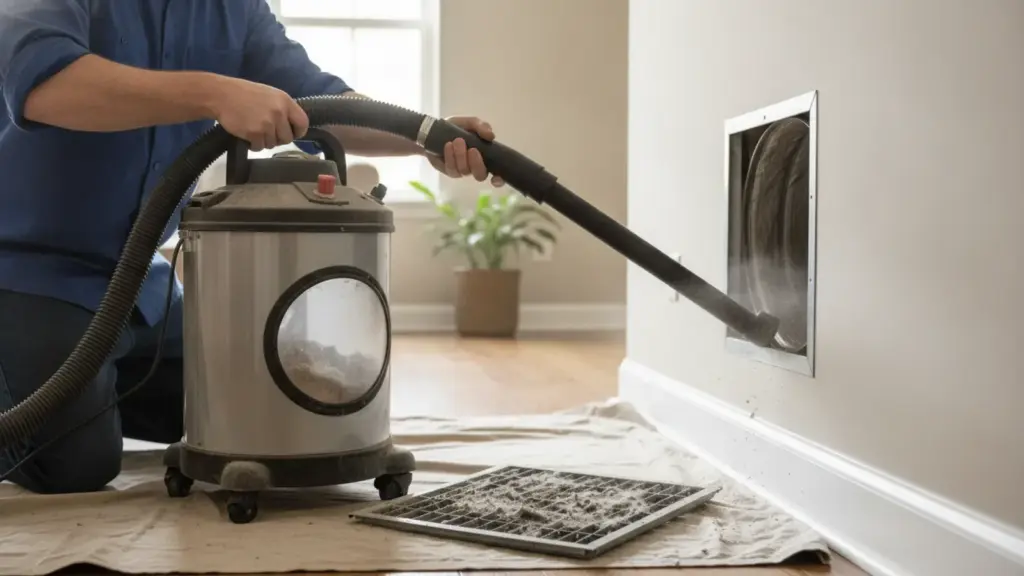
The industry standard, as defined by NADCA (the National Air Duct Cleaners Association), centers on source removal: physically dislodging and then extracting debris from the duct interior rather than simply blowing it around. A proper job typically involves a high-powered vacuum collection unit, rotary brushes or compressed air whips to agitate debris, and negative pressure to pull everything toward the collection point. If a company’s process doesn’t include all three elements, the debris may just migrate further into the system. When you’re evaluating quotes for duct cleaning in Tampa, ask specifically how they create negative pressure and where the collection point is located.
The Components That Often Get Skipped
Ductwork is a system, and cleaning only the main trunk lines while ignoring branch runs is like mopping the hallway but not the rooms. A complete service should address:
- Supply and return plenums (the large chambers attached directly to the air handler)
- All branch ducts leading to individual vents
- Vent covers and grilles (removed, cleaned, and reinstalled)
- The air handler cabinet interior, including the blower compartment and drain pan
- Evaporator coil access area (visual inspection at minimum, cleaning if accessible)
Some companies include all of these as standard. Others treat the air handler and coil area as add-ons. Knowing which category your quote falls into before the crew arrives prevents awkward conversations mid-job.
Sanitizing and Antimicrobial Treatments
After mechanical cleaning, some homeowners opt for an EPA-registered antimicrobial fogging treatment applied to the interior duct surfaces. In Tampa’s humid climate, this can be a reasonable consideration, particularly in homes that have had moisture intrusion or visible microbial growth. However, it’s important to understand that this is a separate step from cleaning, not a replacement for it. Mechanical debris removal has to happen first. A company that leads with sanitizing as the primary service without thorough mechanical cleaning beforehand is reversing the correct order of operations. Ask whether it’s included or optional, and what product they use.
The Real Reason Tampa’s Climate Changes the Calculus
Humidity and What It Does to Duct Interiors
Tampa’s subtropical humidity creates conditions that don’t exist in drier climates. Condensation can form on duct surfaces when cold conditioned air meets warm, humid air that infiltrates through leaks or poorly insulated sections. That moisture, combined with organic debris like dust and skin cells, creates an environment where microbial growth can take hold. This doesn’t mean every Tampa duct system has a problem, but it does mean that a technician here should be looking for signs of moisture during the inspection phase, not just running equipment and leaving. If a company doesn’t mention moisture as a factor in your estimate conversation, that’s worth noting.
How Often Tampa Homes Actually Need Cleaning
There’s no universal schedule that applies to every home. The NADCA guideline suggests inspecting every two to three years and cleaning when inspection reveals meaningful accumulation. In Tampa, a few factors can push that frequency shorter: homes with pets, households with members sensitive to airborne particulates, homes that were recently renovated (construction dust is particularly fine and pervasive), and systems that have had any water intrusion. On the other hand, a well-sealed, recently cleaned system in a household without pets may go longer between services. A company that insists every home needs annual cleaning regardless of condition is selling a schedule, not a service.
Duct Condition and Whether Cleaning Is Even the Right Call
Sometimes an inspection reveals that the ductwork itself is the problem, not just what’s inside it. Ducts that are collapsed, disconnected at joints, or severely deteriorated may need repair or replacement rather than cleaning. Cleaning a compromised duct system can actually dislodge debris into living spaces or fail to address the underlying issue. Ecovent Dryer Duct Solutions Tampa offers both air duct cleaning and air duct replacement, which means a technician can give you an honest assessment of which service actually fits your situation rather than defaulting to the one that was already scheduled.
Red Flags in Low-Ball Quotes
The Per-Vent Pricing Trap
Some companies advertise a low per-vent rate that looks reasonable until you count your vents and do the math. The issue isn’t the pricing structure itself; per-vent pricing can be transparent and fair. The issue is when the advertised rate covers only the vent opening and nothing else, and every additional component (trunk lines, air handler, return ducts) becomes an upsell once the crew is in your home. Ask any company quoting per-vent to clarify exactly what each vent price includes and what the total estimated cost will be for your specific home before anyone shows up.
No Inspection Before Cleaning
A thorough job starts with a visual inspection, ideally with a camera or at minimum a flashlight and a technician who actually looks inside the ducts before turning on equipment. The inspection tells the crew what they’re dealing with: debris type, duct condition, access points, and whether there are any issues (disconnected joints, signs of moisture) that should be addressed before or instead of cleaning. Skipping straight to equipment setup without looking first is a sign that the job is being done by rote rather than by assessment.
Pressure Tactics Around Add-On Services
Upsells aren’t inherently dishonest. Antimicrobial treatment, dryer vent cleaning, and filter replacement are all legitimate services that may genuinely benefit your home. The red flag is when they’re presented as urgent necessities discovered on the spot, with pressure to decide immediately. A trustworthy company explains what they found, why a particular service would help, and gives you the option to schedule it separately if you need time to think.
If you want it handled correctly the first time, consider professional air duct cleaning in Tampa, FL 33609.
How to Compare Quotes Side by Side
When you’re gathering estimates for professional duct cleaning, use a consistent checklist to make the comparison meaningful. Here’s what to ask each company:
| Question to Ask | Why It Matters |
|---|---|
| Does the quote include all branch ducts, not just trunk lines? | Partial cleaning leaves debris in branch runs that recirculates |
| Is the air handler interior included? | The blower and drain pan are major debris collection points |
| What vacuum equipment do you use, and where is the collection point? | Determines whether source removal actually occurs |
| Do you perform a pre-cleaning inspection? | Reveals duct condition and whether cleaning is appropriate |
| Is antimicrobial treatment included or optional? | Clarifies scope and prevents surprise upsells |
| Are vent covers removed and cleaned? | Grilles accumulate dust that re-enters airflow if not addressed |
| What happens if you find disconnected or damaged ductwork? | Tests whether the company offers honest guidance or just continues cleaning |
A company that answers these questions clearly and consistently, without hedging or redirecting, is demonstrating the kind of transparency that carries through to the actual work.
What Good Indoor Air Quality Service Looks Like After the Job
Documentation You Should Receive
After a professional cleaning, you should have some record of what was done. At minimum, this means a service summary noting which components were cleaned, any issues observed (damaged duct sections, signs of moisture, disconnected joints), and any recommendations for follow-up. Some companies provide before-and-after photos from inside the ducts. This documentation is useful for your own records and for any future technician who works on the system.
Filter Replacement and Ongoing Maintenance
A freshly cleaned duct system paired with a dirty or low-quality air filter is a missed opportunity. After cleaning, it’s a good time to install a fresh filter rated appropriately for your system (check your HVAC manufacturer’s specifications for the correct MERV rating, since too high a MERV rating can restrict airflow in some systems). Tampa’s year-round HVAC use means filters load up faster than in seasonal climates, so a monthly check and replacement every one to three months depending on conditions is a reasonable baseline.
When to Schedule a Follow-Up Inspection
If the technician noted any concerns during the cleaning, such as a section of duct that appeared to have moisture damage or a joint that was partially separated, those items deserve a follow-up. Don’t assume that cleaning resolved a structural issue. For most homes without those concerns, the next inspection can wait until the two-to-three-year window unless something changes, like a renovation, a new pet, or a period of HVAC downtime that allowed dust to settle heavily in the system.
Frequently Asked Questions
How long does a professional duct cleaning take for a typical Tampa home?
Most single-family homes take between two and four hours, depending on system size, number of vents, and duct accessibility. Larger homes or systems with difficult access can run longer. Be skeptical of any company promising to finish a full home in under an hour.
Is duct cleaning necessary after buying a home in Tampa?
Not automatically, but it’s worth inspecting. Previous occupants’ pets, smoking habits, or recent renovations can leave significant debris. An inspection before committing to cleaning tells you whether the system actually needs it.
Can duct cleaning improve indoor air quality in Tampa’s humid climate?
Removing accumulated dust and debris from the duct interior reduces the material available to recirculate through your living spaces. In Tampa’s climate, where HVAC systems run almost continuously, that recirculation happens more often than in seasonal climates. Homeowners often notice the air feels noticeably fresher after a thorough cleaning, though results vary by home and system condition.
What’s the difference between air duct cleaning and dryer vent cleaning?
They’re separate systems. Air ducts distribute conditioned air throughout your home via the HVAC system. The dryer vent exhausts hot, moist air and lint from your clothes dryer to the outside. Both require periodic cleaning, but the equipment, process, and safety concerns are different. Ecovent Dryer Duct Solutions Tampa handles both services.
Should I be home during the duct cleaning?
It’s generally a good idea to be present, especially for the initial inspection. Being there allows you to ask questions, see what the technician finds, and make informed decisions about any additional work that might be recommended.
Does duct cleaning also address the dryer vent?
No. Dryer vents are a separate system and require separate cleaning. If you’re scheduling HVAC duct cleaning, it’s a convenient time to ask about dryer vent service as well, since a technician is already in your home and familiar with your setup.
Conclusion
A fair quote for professional air duct cleaning in Tampa isn’t just a number; it’s a description of scope. When you know what a thorough job includes, what drives the cost, and what questions to ask, you’re in a much better position to evaluate what you’re actually being offered. If you’re ready to get a clear, honest assessment of your system, schedule your air duct cleaning in Tampa today and let Ecovent Dryer Duct Solutions Tampa walk you through exactly what your home needs.